Ask an AI search tool what your company charges, and there's a fair chance the answer will be wrong. It quotes a price you dropped two years ago. It lists a service you stopped offering. It names a team size that hasn't been true since 2022.
Most people call this a hallucination. The tool made something up.
Sometimes it did. Often, though, it didn't invent anything. It found an old page, a forgotten directory listing or two sources that disagree, and repeated one of them as fact.
The difference matters more than it used to. In G2's 2026 survey of 1,076 B2B software buyers, 51% said they start their research with an AI chatbot more often than with Google. 64% said they run into inaccurate answers at least a few times a month.
On the screen, a hallucination and a drifted fact look exactly the same. Underneath, they have different causes and different fixes.
Practical example
It wasn't difficult to find an example that illustrates the issue. HubSpot, a giant in the CRM industry, recently updated its pricing model. My intention was to check whether the AI models had picked up the updated information and were providing accurate answers.
Firstly, I've simply asked what is the current pricing for HubSpot's Marketing Hun product and compared it with the information on the website.
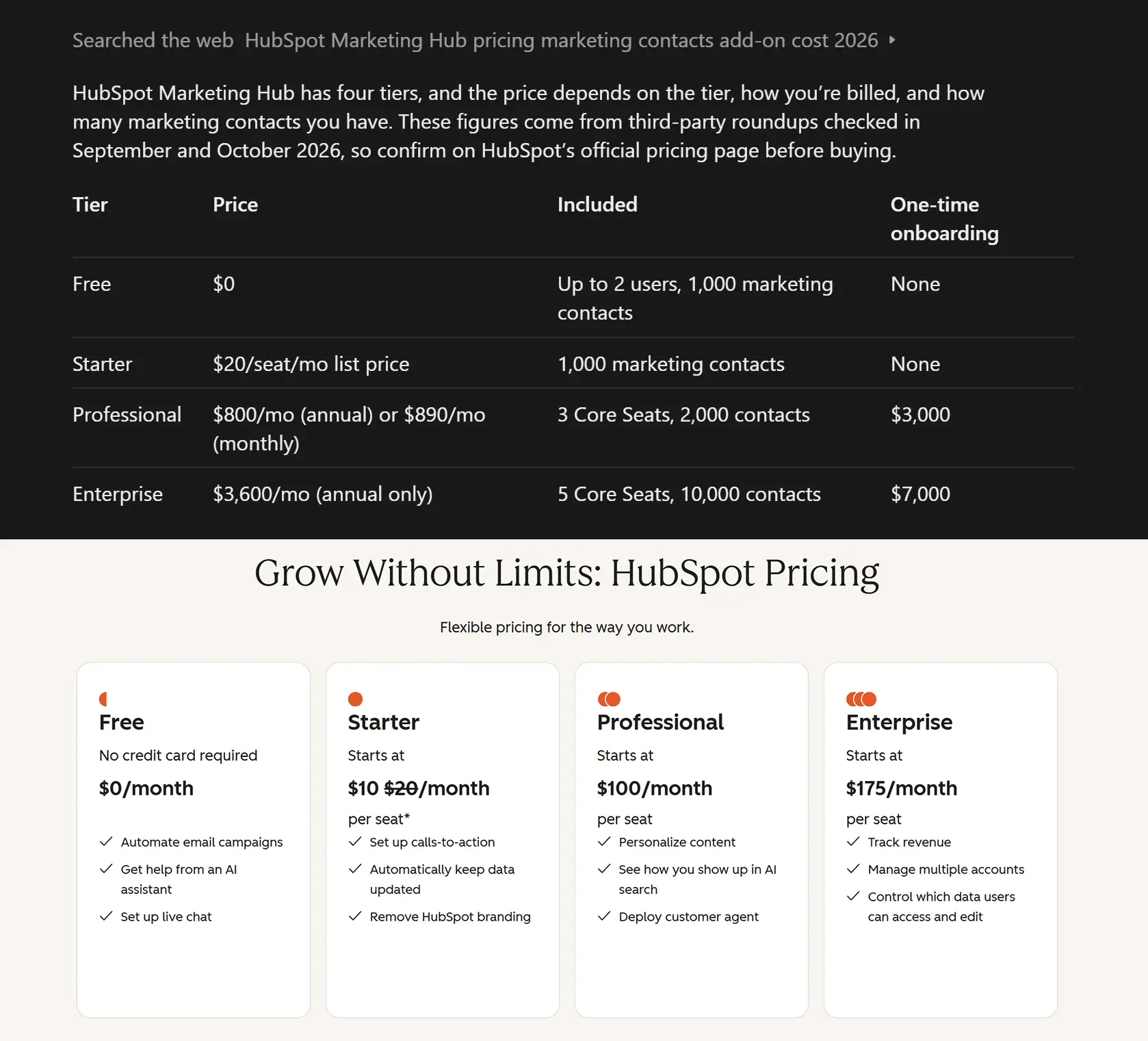
Then I confronted the model directly by sharing the screenshot shown above.
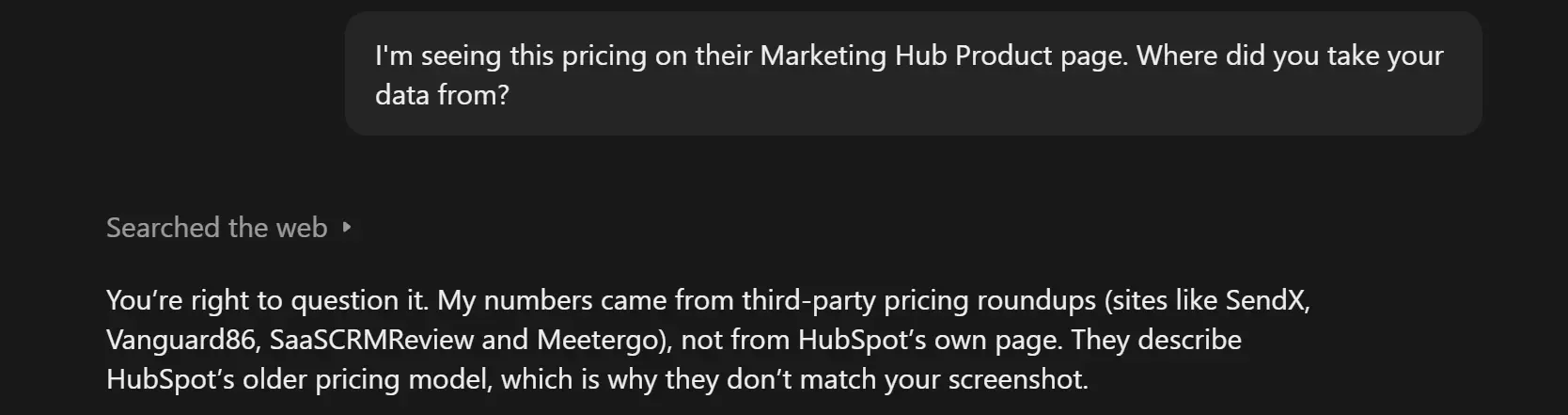
Was this a hallucination? No. This isn't a hallucination. It's what we at Rapid Fire refer to as Brand Drift.
Let's take a closer look at why this happens.
Memory and Search
An AI search tool answers a question about you from two places: what the model underneath it learned in training, and what it finds when it searches the web right now.
Memory
The model was trained on a huge snapshot of the web, taken before a cutoff date. It doesn't keep copies of the pages it read. It keeps patterns.
A fact that appears thousands of times, in the same form, becomes a strong pattern. Ask any of these tools where Apple is headquartered and it won't hesitate. A fact that appears twice, on two pages that disagree, barely registers.
For most B2B companies, that's every fact. Your pricing, your founding year, your service list and your team size might each appear on a handful of pages across the whole web. And anything you changed after the cutoff isn't there at all.
Search
That's why most AI search tools can also search the web before they answer. Google says its AI Overviews and AI Mode may use a technique called "query fan-out": several related searches across subtopics and sources, run at once, to build a single response.

The tool reads what those searches return. Your website, your directory profiles, an old guest post, a review site, a competitor's comparison page. Then it writes one answer.
One answer. Not a list of sources with a note that two of them disagree.
What ends up in that answer depends on what the tool found, and how much of it there was.
Three Outcomes
Every answer an AI search tool gives about you comes from one of three situations.
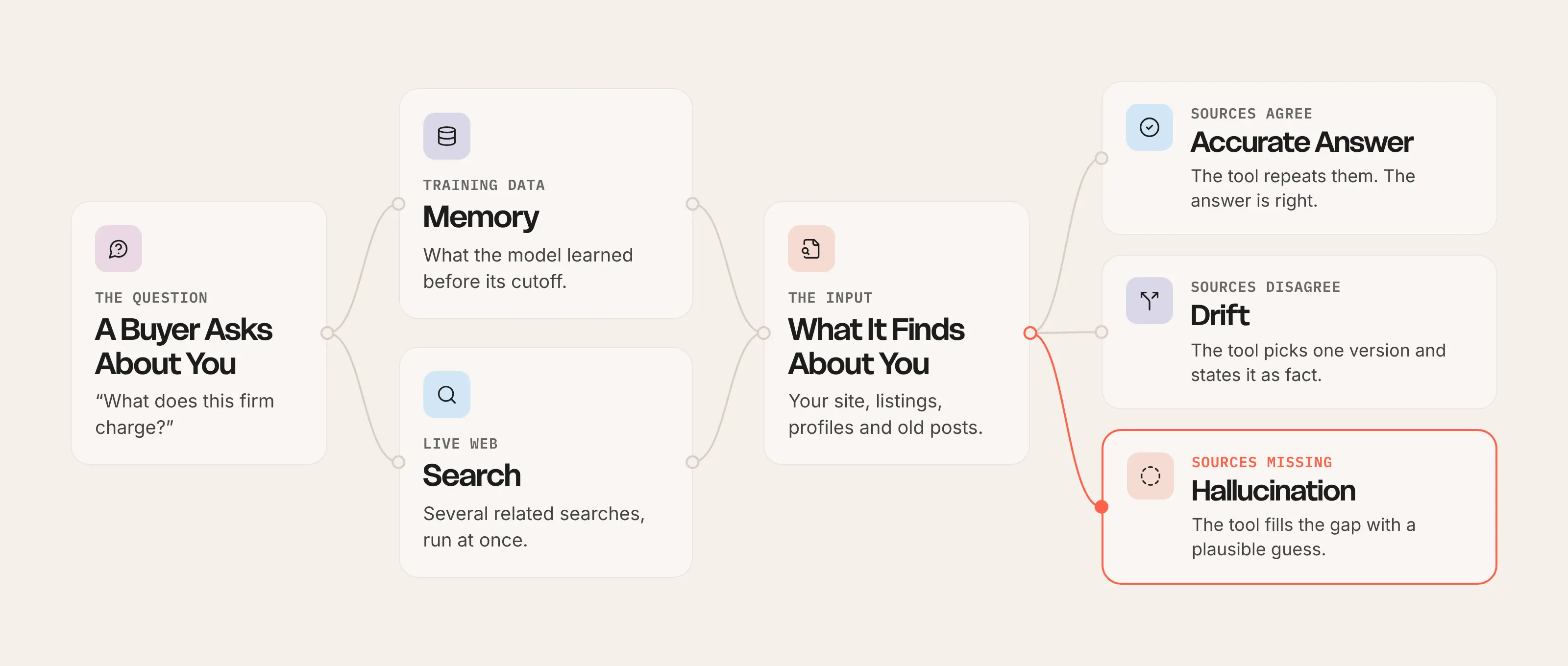
Memory and search feed the same answer. What the tool finds about you decides which outcome you get.
- Plenty of sources, and they agree. The tool repeats them. The answer is right.
- Plenty of sources, but they disagree. The tool picks one version and states it with confidence. That's drift.
- Few or no sources. The tool fills the gap with a plausible guess. That's a hallucination.
Only the third one is the tool making something up. The second is the tool doing exactly what it was built to do, with bad material.
When Sources Disagree
Researchers have a name for this: inter-context conflict. It's what happens when the pieces of information a model retrieves contradict each other. A 2024 survey of knowledge conflicts, presented at EMNLP, lists outdated information as one of the causes: "The retrieved documents may contain updated and outdated information."
That's brand drift, described in academic language. Your pricing page says one thing. A directory profile from 2021 says another. The tool has no way to call you and check which one is current.
So which one wins?
More often than you'd expect, whichever one it reads. In ClashEval, a Stanford study presented at NeurIPS 2024, researchers handed six leading models documents containing wrong information. The models abandoned their own correct answer in favor of the document more than 60% of the time. They were most likely to do it when they were unsure of their own answer.
Now think about how sure a model is about a 20-person consulting firm. Not very. Its memory of you is thin, so whatever page it reads about you carries a lot of weight.
Old pages don't fade out quickly, either. An Ahrefs analysis of 17 million citations found that AI assistants do prefer fresher content, citing pages about 26% newer than Google's regular results. But the average cited page was still almost three years old.
Even researchers who track these failures treat drift and invention as separate problems. When the EBU and BBC tested 3,000+ answers from four AI assistants, 20% had major accuracy issues, "including hallucinated details and outdated information." Two failures, listed side by side.
When the answer is drift, nothing was invented. The tool repeated you. Just an older version of you.
When Nothing's There
The third situation is different. Ask whether you work with healthcare companies, or how long a typical project takes, and there may be no page anywhere that answers it.
Search has a name for this too. In 2018, Michael Golebiewski coined the term data void, later written up with danah boyd at Data & Society: "search engine queries that turn up little to no results, especially when the query is rather obscure."
To a model, most questions about a small B2B company are obscure. There might be a website, a LinkedIn page and two directory profiles. That covers the basics. It rarely covers the specific questions buyers ask before they shortlist someone.
A search engine faced with a data void shows you a thin page of results. An AI search tool faced with one will often still write a complete, confident answer.
This is where real hallucinations live. And they have a cause too.
Why It Guesses
Why doesn't the tool just say "I don't know"?
Because guessing is what it was rewarded for. In September 2025, OpenAI's researchers published Why Language Models Hallucinate, and their explanation is simple. Models are graded like students on a multiple-choice test. A wild guess might be right. A blank answer is guaranteed to score zero. Graded that way, a model learns that guessing pays.
The researchers showed what that looks like in practice. They asked a chatbot for the title of one of the authors' PhD dissertations. It gave three different answers, all wrong. They asked for his birthday. Three different dates, also all wrong.
Birthdays are their example of an arbitrary fact, one that "cannot be predicted from patterns alone." No amount of intelligence tells you someone's birthday. You either read it somewhere or you don't.
Your starting price is an arbitrary fact. So is your founding year, your minimum project size and the industries you serve. No pattern predicts that a 12-person cybersecurity firm starts its retainers at $6,000 a month. If the tool hasn't read it, it guesses.
The paper's own test results show how much the willingness to say "I don't know" changes the outcome:
- gpt-5-thinking-mini said "I don't know" 52% of the time. It was right 22% of the time and wrong 26%.
- OpenAI o4-mini said "I don't know" 1% of the time. It was right 24% of the time and wrong 75%.
Both models got about the same share right. One admitted what it didn't know. The other guessed on almost everything, and was wrong three times out of four.
OpenAI's researchers argue the grading should change, so that honest uncertainty scores better than a confident mistake. Until it does, a gap in what's online about you is a gap the tool will fill.
A confident guess still scores better than "I don't know." So that's what your buyers get.
How to Tell
You can't see inside the model. You can trace the answer, though. When an AI search tool gets something wrong about you, run two checks.
Ask again. Ask the same question three times, in a fresh chat each time, and in more than one tool. A guess tends to change from one try to the next, the way the dissertation title did. A wrong answer that comes back the same every time usually has a source behind it.
Search for the wrong fact. Many tools show the pages they cited, so start there. Then search for the wrong fact itself, in quotes: the old price, the old service name, the old team size. Check your own site first, including old blog posts and FAQs, then your directory profiles, LinkedIn and anything a partner wrote about you.
What you find tells you what you're dealing with:
- The wrong fact is on a page about you. That's drift. Update or remove that page.
- Two of your sources disagree, and the tool picked one. That's drift too. Agree on one version and update every page that carries it.
- The fact isn't anywhere online. That's a data void. Publish the answer clearly, on your own site first.
- Your sources are clear and consistent, and the answer is still wrong. That's a hallucination. Log it, recheck next month, and add the fact in more places buyers read.
Start with the first two. They're the easiest to fix, because the sources are usually ones you can edit.
What You Control
No one can control what AI search tools say about their business. What you can control is most of what those tools read.
When Yext analyzed 6.8 million citations from Gemini, OpenAI and Perplexity, 44% came from brand websites and 42% came from listings. Both are sources a business can update itself. (Yext sells listings management, and its data leans toward local searches. The direction still holds.)
Each of the three situations has its own fix.
- Drift: reconcile. Pull every claim about your business into one place, decide which version is true, and update every page that disagrees. Your website first, then your listings and profiles.
- Data voids: publish. Answer the questions buyers actually ask, in plain sentences, on a public page of your own site. Google says a page has to be indexed and eligible to show in Search with a snippet to appear as a supporting link in AI Overviews or AI Mode. A hidden page made only for bots won't do it.
- Thin presence: get mentioned. In an Ahrefs study of 75,000 brands, mentions of a brand across the web had the strongest link to showing up in AI Overviews (a 0.664 correlation). Backlinks had a weak one (0.218). The more places that describe you accurately, the less room there is to guess.
None of these is a one-off. Your business changes, and every change starts a new gap between what's true and what's online.
Find the Source
This matters because the answer shapes the shortlist. G2 found that 69% of B2B software buyers chose a different vendor than they had planned because of an AI chatbot. Buyers also told G2 they treat inconsistent answers across chatbots as "a red flag."
So before you blame the tool, trace the answer. Here's a check you can run this week:
- Write down five questions a buyer asks before contacting you: what you charge, who you work with, what you do, how big you are and how you compare to your closest competitor.
- Ask each one in ChatGPT, Perplexity and Google's AI Mode, three times each, in a fresh chat every time.
- For every wrong answer, find where it came from, using the list above.
You'll end up with three short lists: drift to fix, gaps to fill and true hallucinations to watch.
That's the work behind Zero Drift, our framework for keeping a business's facts consistent everywhere buyers and AI search tools read about it. We find every place your story splits, settle it with you, publish it where it counts and check every month that it stays that way.
If the answers you get sound like someone else's company, let's talk.