




Recently, we ran a check on our own brand. We pulled every claim about Rapid Fire we could find: our service pages, our FAQ, our llms.txt file, and the agency directories we signed up for years ago. Then we compared them line by line.
Despite our diligence, the information available online conflicted in eight different places. Nobody got anything wrong on purpose. Every claim was true when it was written.
But a result our identity just drifted.
How Brand Drift Happens
Brand drift is the gap between what your business is today and what the internet says it is. It builds up one sensible update at a time.
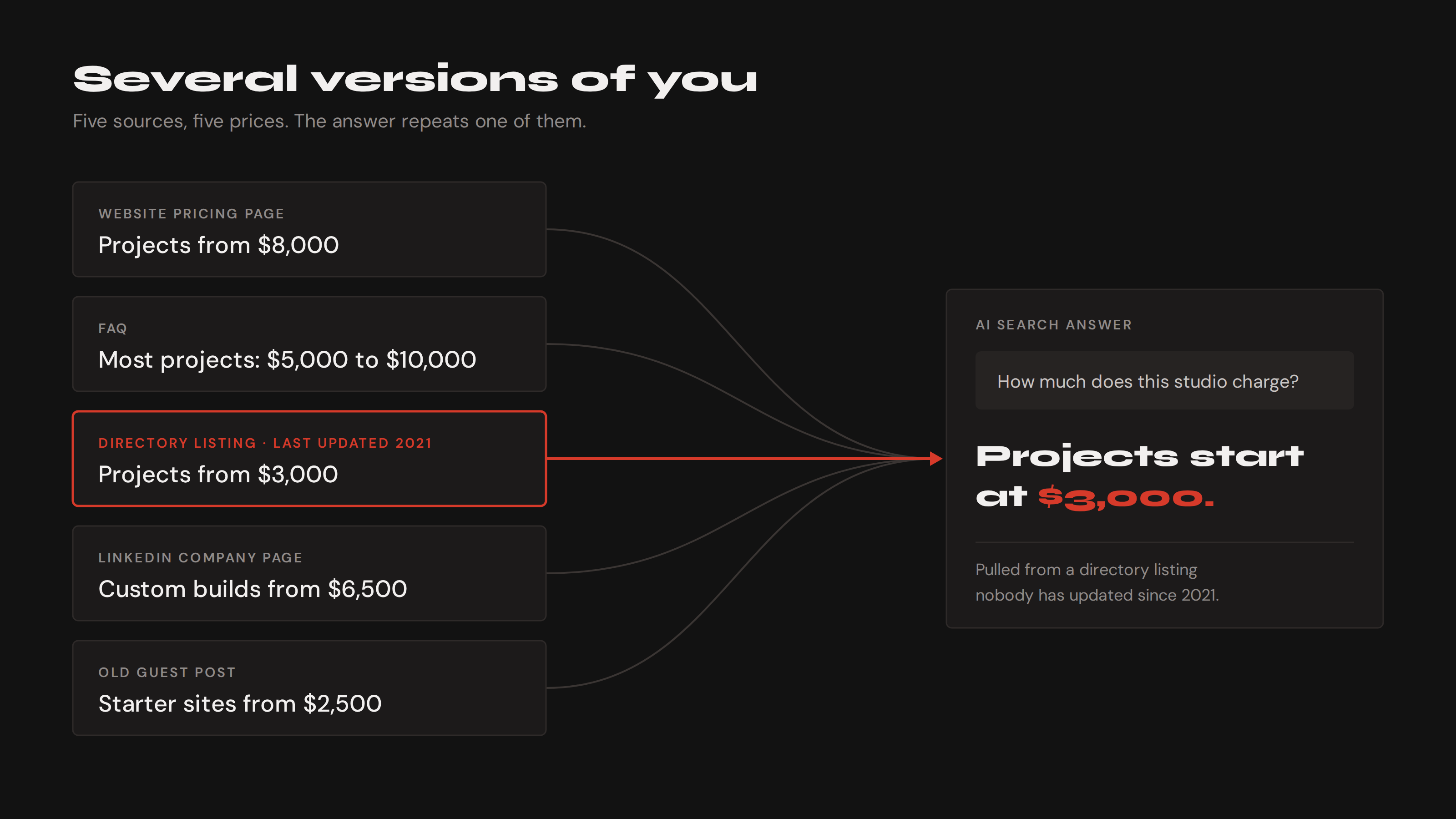
You raise your prices and update the pricing page, but not the FAQ. You rename a service on the homepage, and the old name lives on in three blog posts. You set up a directory profile in 2021 for a backlink and never log in again. Your sales deck says one thing, your website says another, and a partner's page still describes the company you were two years ago.
Each change makes sense on its own. Together, they add up to several versions of your company, all live at once.
For most of the web's history, that was a nuisance. A prospect spotted an old price and asked about it on a call. Someone on your team cleared it up, and the deal moved on.
That safety net is gone.
Why It Matters Now
Buyers now ask AI search tools for a shortlist before they visit a single website. "Best Webflow studio for a SaaS company." "How much does this agency charge?" "Do they work with companies our size?"
The tool reads what it can find about you, on your site and everyone else's, and writes one answer. It doesn't know which version of your pricing is current, and it doesn't call you to check. It picks one version and states it with total confidence.
When it picks the wrong one, three things can happen:
- A buyer who fits perfectly sees an outdated price and rules you out.
- A buyer who doesn't fit sees a lower price and books a call you'll spend declining.
- A buyer asks for a shortlist in your category, and you're not on it, because the tool couldn't piece together a clear picture of what you do.
Is that the tool's fault? Partly. But it can only repeat what's out there, and what's out there is usually several versions of you.
You don't lose the lead. You never meet it.
The Zero Drift Framework
Most brands don't have a messaging problem. They have a maintenance problem.
The message was right when someone wrote it. But a business keeps changing, and the places that describe it don't change with it. Fixing one page does little when the same fact lives on a dozen others, some of them on sites you don't control.
Drift also falls between roles. Marketing owns the message. Whoever built the site owns the pages. Directory profiles belong to whoever set them up years ago. Nobody owns the whole picture, so nobody notices when the pieces stop matching.
Zero Drift puts one person in charge of the whole picture.
The name comes from measurement. Drift is what happens when an instrument slowly stops reading true. Nothing breaks. The readings move a little further from reality every month, until someone resets the instrument to zero. The fix isn't a better instrument. It's a fixed reference point and regular checks against it.
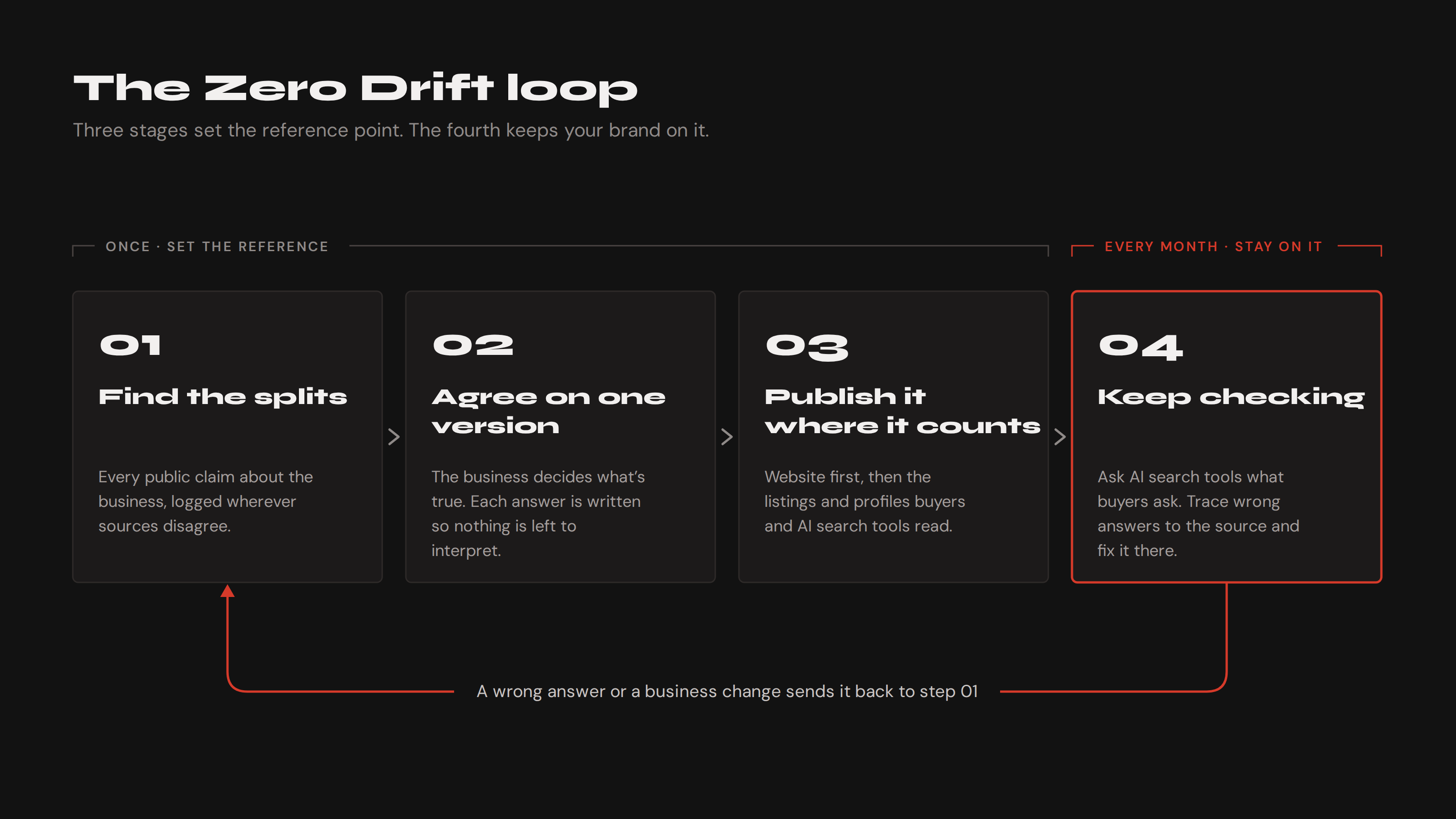
Zero Drift applies the same idea to your brand, in four stages:
- Find the splits. Collect every public claim about the business, from the website to directories to old guest posts, and log every place they disagree.
- Agree on one version. The business decides what's true. Each answer gets written clearly enough that there's nothing left to interpret.
- Publish it where it counts. The website first, then the listings and profiles that buyers and AI search tools read.
- Keep checking. Every month, ask AI search tools the questions buyers ask. When an answer is wrong, trace where it came from and fix the source.
The first three stages set the reference point. The fourth keeps the brand on it, because the business keeps changing, and so do the tools.
No one can control what AI search tools say. What you can control is what they read, and whether all of it tells the same story.
Signs Your Brand Has Drifted
- Your pricing or packages changed in the last year.
- You've renamed, added or dropped a service.
- You have directory profiles nobody has logged into in years.
- Prospects show up to calls with the wrong idea of what you do or what you charge.
- You ask an AI search tool about your company and don't recognize the answer.
If two or more sound familiar, you have drift.
Check Before Your Buyers Do
Open ChatGPT, Perplexity or Google's AI Mode. Ask what your company charges, who you work with, and how you compare to your closest competitor. Read the answers the way a buyer would.
Then decide who finds the drift first: you, or your next buyer.
Zero Drift is part of how we work with clients now. We set your reference point, then keep your brand on it month after month. If AI search tools are telling your story wrong, get in touch and we'll help you fix it.