




The email landed on May 13. I was buried in client work and the usual business management, and I almost missed it entirely. Maybe Webflow sent advance notice somewhere. Maybe they didn't. Either way, the changes were live by the time I sat down to read them.
As an agency owner who builds on Webflow daily and manages a client base where most sites sit on one or the other Webflow plan, my first instinct was to dig in. Here's what I found.
Overall Impression
The headline change is the consolidation of the CMS and Business plans into a single new tier called Premium. Most of our clients are on one or the other, so this affects nearly everyone we work with. New site plan purchases move to Premium immediately. For existing customers, the changes take effect at the next renewal or billable change — June 29, 2026 for most workspaces, and November 16, 2026 for sites hosted in Agency or Freelancer workspaces.
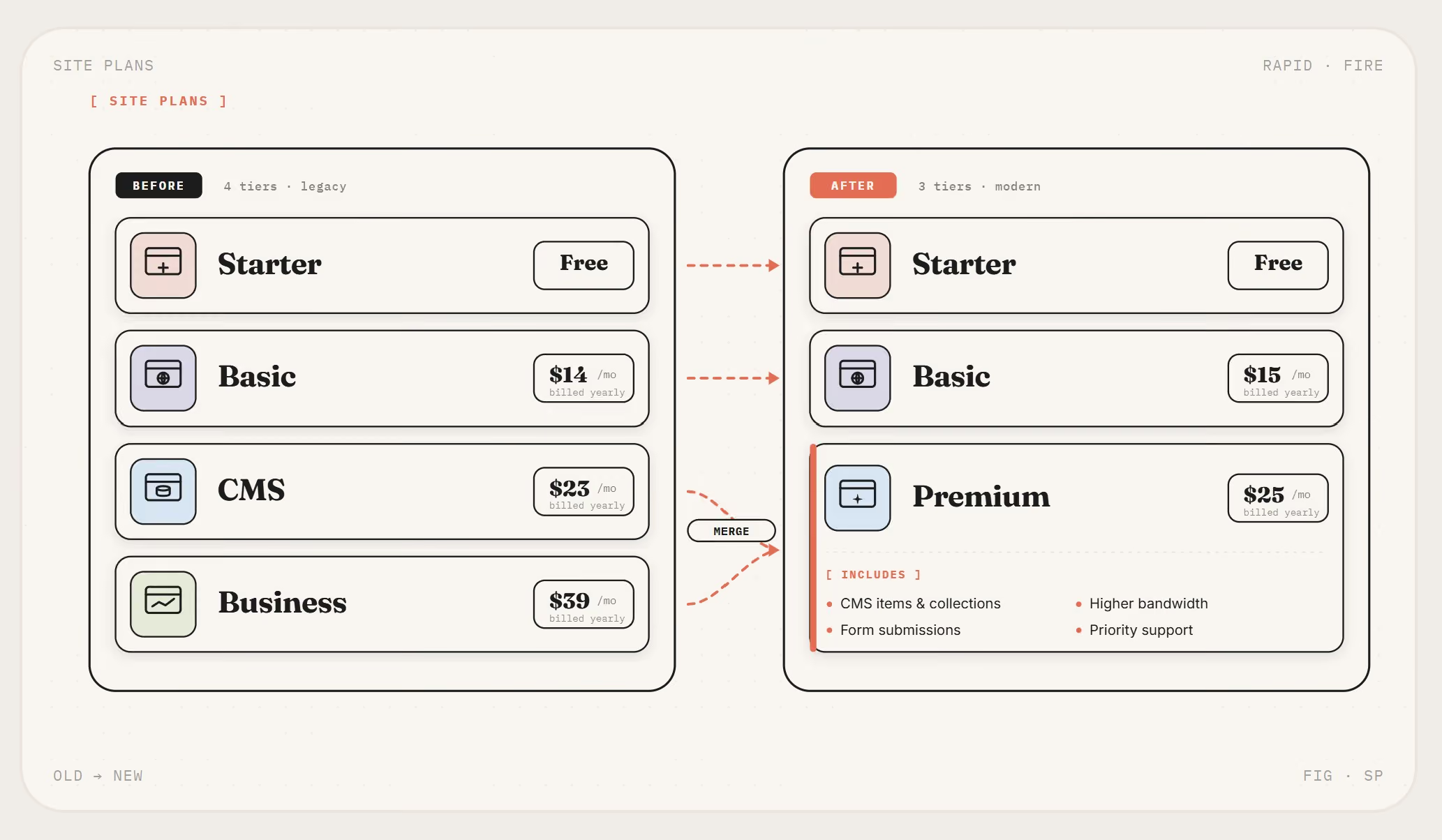
For former CMS plan customers, that's a $2/month increase on annual billing. For former Business plan customers, the base price actually drops — from $39/mo to $25/mo annually. That sounds like a win until you look at what changed underneath.
The biggest change is bandwidth. The new Premium plan includes only 50GB/mo at the base price. Former Business plan customers had 100GB included. To get back to that level, they'll need a $20/mo add-on — putting their effective cost at $45/mo, a $6 increase. So the lower headline price doesn't tell the full story for high-traffic sites.
Another thing that caught my eye right away is the gap between paying monthly versus annually — roughly 36% on the Premium plan. It's probably one of the biggest differences I've seen for any SaaS product. Why is Webflow doing this? I'm not their business analyst, but my guess is they've calculated how many people launch a website as an MVP, test the idea for a few months, realize it's not worth pursuing, and cancel their monthly subscription. With such a steep difference, those people may be persuaded to buy annual right away. I see a risk that some of them will turn even more toward vibe coding to test their products instead — but Webflow has probably calculated that too.
Basic plan users will see a $1 increase when billed annually. As an agency, we create very few websites where the Basic plan is sufficient, so that's not really where my focus is.
The next big "what the heck" moment is the Team plan — a completely new plan with brand-new positioning and a new audience. It now captures those who've outgrown the Business plan but can't afford Enterprise. Smart move. We have a number of clients in exactly that position. I'll cover this in more detail later in the article.
What the New Pricing Means for Former CMS and Business Plan Customers
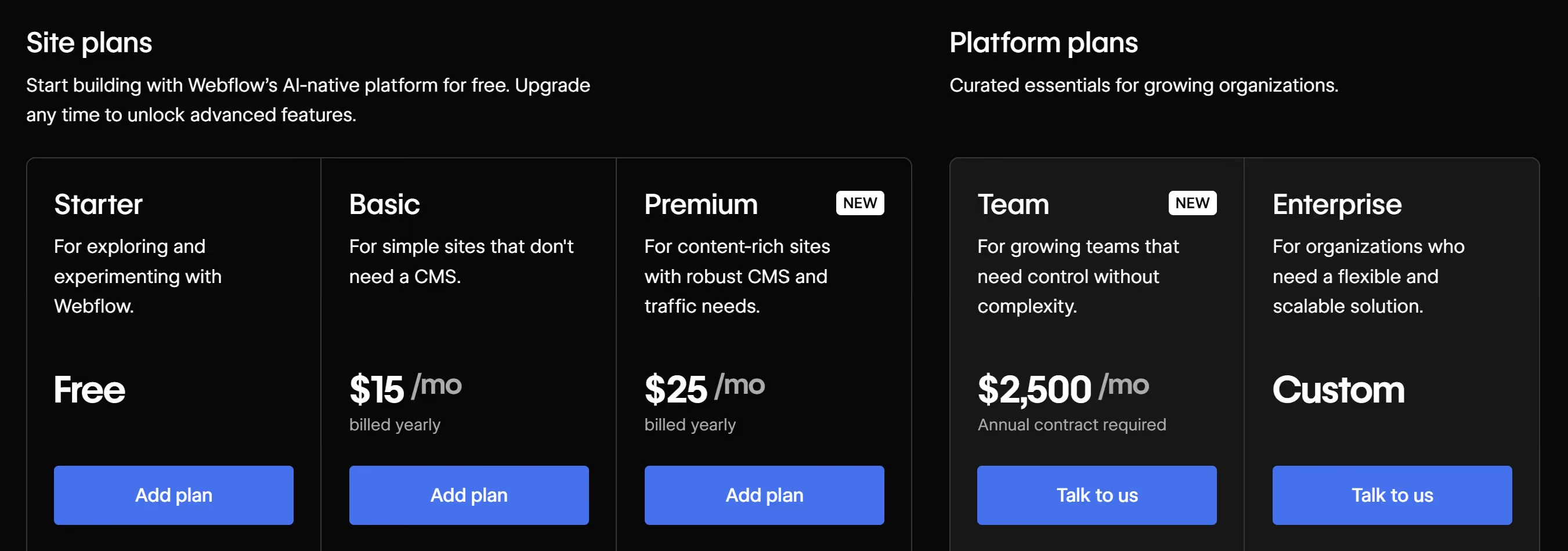
The new Premium plan is described on the pricing page as "For content-rich sites with robust CMS and traffic needs." The "traffic needs" framing is doing a lot of work there, because it's exactly what makes the plan's true cost so variable.
Base price: $25/mo annually. For that, you get 50GB of monthly bandwidth — which is a reasonable number. It covers a small to mid-size corporate or business website with roughly 10,000 real visitor sessions. Enough for most, but not all.
If you need more, the ladder goes:
- 100GB — $45/mo
- 150GB — $64/mo
- 200GB — $85/mo
- 300GB — $125/mo
- 500GB — $200/mo
- 750GB — $300/mo
- 1TB — $400/mo
- 1.5TB — $600/mo
- 2TB — $800/mo
- 2.5TB — $1,000/mo
Note: starting from 500GB, I rounded up to the nearest hundred — you know why.
There's a reasonable argument to be made here. If you need 1TB of bandwidth, your website has solid traffic that hopefully converts to paying customers and generates revenue that can easily cover $400/month for a revenue-generating asset like your website.
On the upside, former CMS plan customers are genuinely getting more. CMS item limits go from 2,000 to 20,000. Collections increase form 20 to 40. Static page count doubles. Form file upload — previously a Business-only feature — is now included. And search indexing gets faster. For $2/month more on annual billing, that's a real increase in value.
Former Business plan customers keep their CMS collection limits (but get a 10,000 increase in Collections items) and most of their features, but should check their bandwidth usage before their renewal date.
My honest read: former CMS plan customers come out ahead. Former Business plan customers need to run the numbers.
The Team Plan — For What Teams, Really?
My first reaction to the Team plan was a confusion. It costs $2,500/mo billed annually only — $30,000 per year and it sits visually much closer to Enterprise on the pricing page than to Basic or Premium. Actually, while Basic and Premium are positioned as website plans, Team and Enterprise are positioned as platform plans.
Once I looked past the price, the contents started making more sense. What you get:
- Hosting + CMS
- 5 full + 5 limited seats
- 2 locales
- Publishing workflows and page branching
- Single-page publishing
- SSL certificates + security headers
- AEO agents (coming soon)
- 30TB bandwidth
- 24/7 priority support
That's a meaningful bundle for a team that has genuinely outgrown self-serve but can't justify an Enterprise contract. We have clients in exactly that position. Every item on that list is something a larger team eventually hits a wall without.
The AEO agents I'm holding at arm's length for now. Webflow has a pattern of announcing AI features with some fanfare and then releasing them carefully. Rushed AI features cost more in trust than they gain in attention. I'd rather they ship it properly.
The Team plan makes sense for a specific kind of client: one where the website is operationally central, where publishing governance actually matters, and where the cost of slow workflows has a real dollar value. If that's not your situation, the price doesn't justify it.
AI Credits — Tell Me What I Need Them For
Starting May 13, AI credits are included across all Workspace plans. Free workspaces get 200 credits/mo, Core and Freelancer get 300, Growth and Agency get 400, Team gets 100,000 per year. Credit limits won't be enforced until June 29, giving everyone a window to understand usage before anything changes.
The features that currently use credits: improve SEO and AEO, generate copy, generate CMS collection items, generate code components.
That list is short. I think it's intentionally short — Webflow is laying the infrastructure now and plans to expand from there. The credit model makes sense as a scalable container for that expansion. The usage isn't priced at a fixed rate per action, and Webflow reserves the right to adjust rates as AI costs evolve. That's understandable from their side, but it makes budgeting for AI usage genuinely difficult.
We use AI tools extensively in our workflows and all of them are paid. If Webflow's AI features mature to the point where I can shift some of that work inside the platform at comparable quality, I'm open to it. I just need the feature list to catch up to the credit infrastructure first.
Conclusion
My first reaction was negative. The previous bandwidth pricing change hit some of my clients harder than it should have and generally felt like an attempt to get more money without providing additional value, and I walked into this announcement carrying that memory.
After working through the details, I see more logic here than I expected. The plan merge was overdue. The Team plan fills a real gap in the market. The AI credit system, even with its vagueness, signals that Webflow is building toward something rather than just repricing what already exists.
Webflow waited long enough to see what AI features they could actually deliver and how the market was responding. Once the vibe coding hype settled and people started realizing that a manageable, scalable website still needs a real platform behind it, Webflow made their move.
I think it was the right time. I'm watching closely to see if the delivery matches the positioning.