




AI content tools have made it easier than ever to produce more. More blog posts, more social captions, more copy at every touchpoint. Teams that used to publish twice a month are now publishing twice a week.
The volume is there. The identity is not.
Here Is What Happens Without a Documented Standard
You open a tool and type a prompt. The output is clean, readable, competent. You use it. Next week you do it again. And again.
Over time, the content multiplies but it starts to converge. The sentences follow the same rhythm. The framing hits the same notes. The vocabulary flattens into the same comfortable, professional sameness that every other brand using the same tools is producing.
You start sounding like everyone else in your market. Not because the content is bad. Because it is not anchored to anything specific about you.
Most brands using AI to scale their content are not building an audience. They are training their audience to ignore them. You cannot automate your way to being remembered. No defined voice means the default is average, and average at scale is just noise. - Karina Demirkilic, founder of Rapid Fire Web Studio
Brand Voice Is Not a Vibe
There is a common misconception that brand voice is something you feel, not something you define. That it comes naturally once the visual identity is strong enough.
It does not.
Visual identity and verbal identity are two separate systems. A well-designed site can still undermine itself the moment a reader encounters a headline that sounds hesitant, a service page that sounds aggressive, or a blog post that sounds like it was written by someone who has never met the company.
Brand voice is the consistent personality behind every word you publish. It shapes how your audience interprets your competence, your values, and your reliability. It is not a tone you switch on for marketing copy. It applies everywhere: your website, your email responses, your LinkedIn posts.
When it is consistent, it builds trust. When it is inconsistent, it introduces doubt. Quietly, persistently, expensively.
What Inconsistency Actually Costs You
The cost is rarely visible in a single piece of content. It accumulates.
Without a documented standard, every writer, every freelancer, every new hire makes their own judgment call about how your brand should sound. Some will get it right. Most will approximate it. None of them will be consistent with each other.
Generic or inconsistent content does not just get ignored. It raises a question the reader never says out loud: if this is how much effort they put into what is visible, what does their actual work look like?
Your content is a sample of how your business thinks. Publish generic, and you are telling the market your standards are generic too.
What a Tone of Voice Document Actually Contains
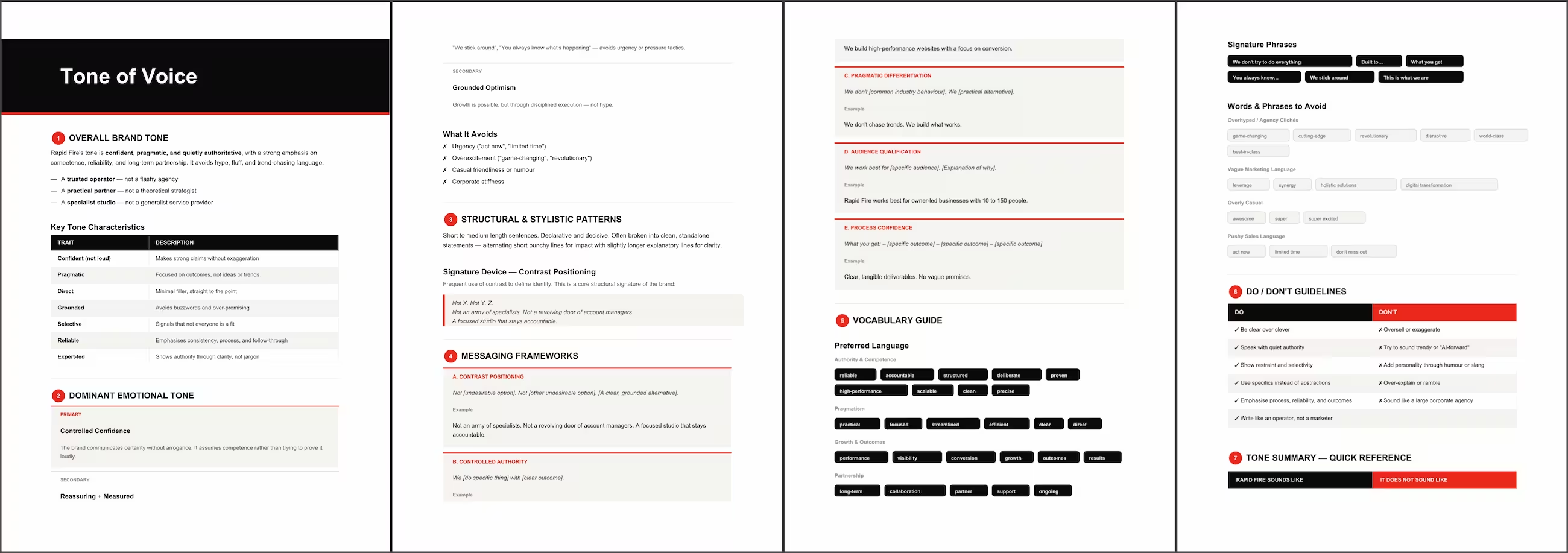
A tone of voice document is not a mood board or a mission statement. It is an operational reference — something anyone writing on behalf of your brand can open, follow, and produce consistent output from. That includes your writers, your freelancers, and your AI tools.
A well-built document covers a few specific things.
The core personality. What are the two or three dominant characteristics of how this brand sounds? Confident but not aggressive. Direct but not cold. These need to be defined precisely, not left open to interpretation.
What to avoid. Defining what you are not is as important as defining what you are. The list of words, phrases, and registers to avoid is often more useful than the list of recommended ones.
Sentence structure and rhythm. Long and nuanced, or short and punchy? Does the brand use rhetorical questions? Does it write in the first person? These structural choices create a recognisable rhythm across all content.
A vocabulary guide. Preferred language for your category. Words that are off-limits. When industry jargon is appropriate. This removes the guesswork.
Examples. Before and after rewrites. Annotated real content. Showing what the standard looks like in practice is more effective than describing it in theory.
How This Works in Practice
When we take on content work for a client, tone of voice documentation is part of the process. Not a nice-to-have. Not something we revisit when the writing starts feeling off.
We have a client for whom we consistently produce content at scale. We invested time and resources and built a documented voice standard for them. What followed was a measurable shift in how efficiently we produced content and how consistently it landed.
Without that documentation, a significant amount of editing time went toward correcting patterns that AI writing tools default to when they have no defined input. Generic sentence structure. Neutral vocabulary. Readable, personality-free prose that disappears the moment a reader finishes it. Every piece needed to be pulled back into shape before it could go anywhere near publication.
With the documentation in place, that problem is solved once.
The standard exists. The tools are given something specific to work with. The outputs come back coherent.
What we focus on now is the work that actually requires judgment: finding a strong topic worth covering, fact-checking claims and sources, choosing the right angle for the audience, building in practical examples that make the piece useful. The voice is already handled. We do not spend time correcting it on every piece.
That is the direct operational difference documentation makes. Not a philosophical commitment to brand consistency. A reduction in wasted editing cycles and a concrete improvement in output quality.
Where to Start
If your current content sounds inconsistent, the problem is rarely the individual pieces. It is the absence of a shared standard behind them.
We work with founders and marketing leaders at growing businesses who know their brand voice when they hear it — they just have never been able to write it down in a way that scales. Our process starts with understanding how your business thinks, how your best clients describe the value you provide, and what your communication should feel like at every stage of the buyer journey. From that, we build a documented standard your whole team can use.
The output is practical. A reference document, not a philosophy paper. Something you can hand to a new hire, a content agency, or an AI tool — and know that what comes back will sound like your company.
If your site is due for a rebuild, or you are producing content without a documented voice to anchor it, this is the right time to fix the foundation.
Get in touch and we will start with a conversation about where your brand voice stands today.