




Websites for media and editorial platforms
Your content is the product.
Your website should be built to publish it, rank it, and grow it.
We work with digital magazines, niche editorial brands, newsletter-first publishers, and content platforms that have outgrown their current site. If publishing is slow, the CMS fights your editors, or the archive is not pulling the search traffic it should, that is the problem we solve.







What problem do we solve?
Your readers, your advertisers, and your search rankings all depend on the site. A reader who lands on a slow page leaves before the story loads. A sponsor who checks your site forms an opinion in seconds. And an editorial team that needs a developer to publish stops publishing as often as it should.
A broken CMS does not just frustrate the team. It caps how much you can publish, how much of the archive gets found, and how seriously the people who fund the work take you.
The good news is it is a fixable problem.
What we do for content platforms
Most publishers we work with are dealing with one of three situations. Here is how we approach each one.

Foundation
The platform is often the real problem. The site is slow, hard to update, and increasingly difficult to build on. Design is part of the issue, but it is rarely the whole story.
We assess what you have and build what you actually need. That might mean migrating from WordPress to a platform that gives your marketing team real control. It might mean rebuilding what exists, or restructuring a Webflow site that was set up poorly. In every case, the result is the same: a clean, scalable foundation that your business can grow on.

Maintenance and Support
You have a marketing person in-house or you work with SEO agency. What you do not have is a developer.
We sit alongside your team as the technical resource. New pages, CMS updates, design changes, performance fixes. You brief us, we build it. No agency overhead, no hiring process, no waiting three weeks for a small update.

Growth Management
Once the site is live, it needs ongoing work to keep bringing in business. If there is no marketer in-house yet, that work usually does not happen.
We run a monthly plan for your Webflow site covering conversion optimization, Modern SEO, performance monitoring, and Zero Drift, which keeps your business described the same way everywhere. Content production supports the SEO work. You can start with one service and add more later, and every plan runs in monthly cycles with reporting.
Managing and regularly updating historical information using informative webpages has been a challenging but rewarding experience. I did not have the expertise to make it work in a practical and useful way. As a birthday present, my children arranged to hire Karina to come up with a workable solution - she designed and built an incredible history saving machine that has grown with time to the point that over 1.9 million visitors have dropped in to have a look at the web pages. ...
... I would recommend her services to anyone who wants to have a site built for themselves. Should you choose to make use of her skills, you will be well served.


The BEST team for my Website Development
I’ve been working with Karina since the very beginning of our website, almost four years now, and she has been an absolute pleasure to work with! She and her team are incredibly responsive, professional, and easy to collaborate with via email. They make everything seamless and give me examples since I'm not an expert in this field. I’m based in California and my only wish is that I could work with Karina on even more projects. I can’t recommend her and her team enough!

Which Content Platforms Do We Work With?
We work best with editorial teams between 10 and 150 people, where the founder, editor-in-chief, or head of content has reached the point where the site is holding the publication back. The pain is usually specific: a CMS that breaks every time someone tries to add a new content type, a publishing workflow that runs through a developer, or an archive of hundreds of articles that search engines barely surface.
This is not the right fit for every publisher. If you are looking for the cheapest path to a new site, or a one-off build with no ongoing relationship, we are probably not your best option. We perform best with teams that want a partner who stays involved after launch and keeps the site growing alongside the content.

Newsletter-First Media Brands
Creator-Led Media Brands

Research & Data Publishers
Book Publishers & Author Platforms
Content Studios & Branded Content Agencies
Independent News Outlets
Podcast Networks & Audio Studios

Trade & Industry Publications

Niche Editorial Brands
Digital Magazines & Online Publications
Documentary & Video Production Studios
Do We Get What It Takes to Build a Content-Driven Website?
The CMS is the business. Content types, categories, authors, series, tags, and related content have to be modelled properly from the start. Get the structure wrong and every new format becomes a workaround. Get it right and editors publish without asking anyone.
Search is the pipeline. Most of your audience arrives from Google, and increasingly from AI answers. Page speed, clean structure, schema, and internal linking decide whether a piece gets found six months after it was published or disappears the week after.
The reading experience is the brand. Typography, layout, image handling, and how ads or newsletter prompts sit on the page decide whether a reader finishes the piece and comes back. A site that is hard to read loses the audience before the writing gets a chance.
Volume changes everything. A site with 40 pages and a site with 4,000 articles are different engineering problems. Archives, pagination, filtering, and load time all have to be planned for the size you are growing into, not the size you are today.
How engagement works
Every engagement starts the same way: a direct conversation with our founder, Karina Demirkilic.
Discovery
We look at where your site is falling short, what your team needs day to day, and where the business is trying to go. No assumptions. By the end of that call, we have a clear picture of your situation and can tell you honestly which of our services applies.
Scope and options
Based on what we learn, we define the scope and present your options. That might be a platform migration and redesign, maintenance support, growth management, or a combination. You choose what fits your current needs. Nothing is pushed on you.
Kickoff
Once the engagement is confirmed, you are assigned a dedicated project coordinator. They keep the work on track, ensure communication is timely, and make sure no request falls through the cracks. You always know what is happening and who to contact.
Delivery
We do what we said we would do. Template-based builds take 2 to 4 weeks. Custom builds take 2 to 4 months, from strategy to handoff and training. Maintenance engagements can run on a defined monthly retainer or on an ad hoc basis, depending on what your team needs. Growth management runs on a monthly cycle with clear deliverables each period. Where monitoring and reporting are part of the scope, you get a consistent view of what is working, what has changed, and what comes next.
No guesswork, no chasing us for updates.
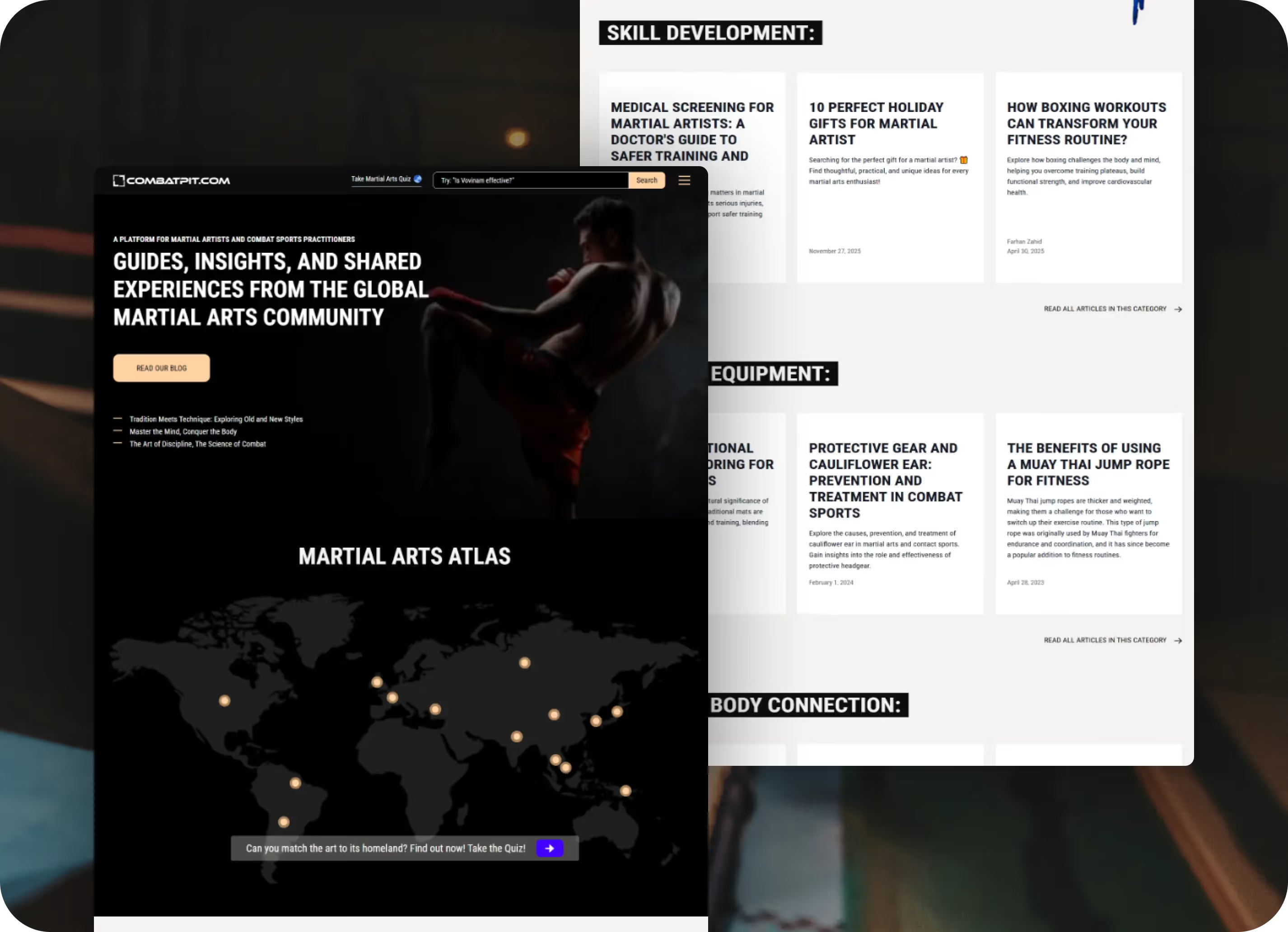
Combatpit — Blog About Martial Arts
Learn about our journey in creating a scalable, SEO-optimized, and user-friendly platform where martial arts enthusiasts meet.
Everything You Need to Know
We’ve gathered the questions we hear most often to make sure you feel confident before moving forward.
Yes, within limits you should know before you commit. Webflow CMS scales to 10,000 items per collection on Business plans and further on Enterprise, and we have run editorial sites well into the thousands of articles without performance problems. The constraint is not the number of posts, it is how the collections are structured. We model content types, categories, and relationships so the archive stays fast and navigable as it grows. Another concern is the cost of bandwidth. If your volume is genuinely beyond Webflow capabilities or reasonable pricing, we will tell you on the discovery call rather than build something that breaks in year two.
That is the point of the build. Editors get a CMS with the fields they need, clear labels, and nothing extra to break. Publishing a piece, scheduling it, swapping a hero image, or adding an author should take minutes and no developer. We also offer Webflow tutoring for editorial teams if you want everyone trained on day one instead of learning as they go.
Yes. We map your existing content types, categories and tags to a clean Webflow structure, then move your articles with their images, authors, categories and publish dates. We keep your URL structure and metadata wherever possible and set up redirects for anything that changes, so readers and search engines land on the right page. We plan the move around your search traffic and monitor it after launch. Rankings rest with Google, so we cannot promise them, but protecting the pages that already perform is the priority in every migration.
Yes. Video embeds from Vimeo, YouTube, or your own hosting, image galleries, long-form layouts with pull quotes and inline media, and interactive elements built with custom code. For production companies specifically, we build portfolio and project pages around the work itself so the reel or the stills carry the page. The format follows the content, not the other way around.
Structure first. Clean URLs, category and tag pages that actually rank, schema markup for articles, authors, and video, fast load times, and internal linking that surfaces older content. We also optimise for AI search engines, which increasingly cite well-structured editorial content directly. If you take us on for Growth Management, we run this continuously and report on what is gaining and what is slipping.
Yes. Ad slots for Google AdSense, Mediavine or similar platforms or a direct-sold program, sponsored content types with proper labelling, newsletter capture, and gated or member-only content through Memberstack.
Both. We run two editorial platforms, so the team knows what a CMS looks like after two years of daily publishing, how editorial calendars actually work, and where a badly structured site starts costing you time. We build with that experience, not from a spec sheet.
Yes. Mailchimp, beehiiv, Substack, ConvertKit, and similar for newsletters. GA4 and Plausible for analytics. Automated social posting. AI agents that help to speed up the process.
We stay. Most editorial clients move into a Maintenance retainer after launch, which means new content types, layout changes, performance fixes, and CMS adjustments happen on a defined schedule with a named project coordinator. You brief us, we build it, and publishing never waits on a developer who has moved on to another project.